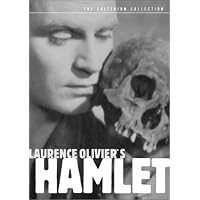
Average Reviews:

(More customer reviews)Are you looking to buy Hamlet (The Criterion Collection) (1948)? Here is the right place to find the great deals. we can offer discounts of up to 90% on Hamlet (The Criterion Collection) (1948). Check out the link below:
>> Click Here to See Compare Prices and Get the Best Offers
Hamlet (The Criterion Collection) (1948) Review
Laurence Olivier's Hamlet, at 153 minutes, is no popcorn flick. However, in order to get the film down to this rather long length, Olivier had to make significant cuts to the famous Shakespearean play. As a film that won four Oscars, this is (was) mainstream entertainment. Presenting Hamlet in its entirety (or even close to its entirety) under these circumstances was therefore an impossibility. Olivier's modifications come in three forms: small deletions from speeches and conversations, "streamlining" of main story lines, and cuts of entire subplots. The first, least drastic change, leads to the second, and finally the third, and greatest, of the changes. The cutting of lines has the least effect on the production's ability to tell the story. The removed lines are usually unnecessary and repetitive, and the transitions are smooth. Without a written version of the text in front of him, a viewer (unless he knows the play extraordinarily well) can rarely pick out where a line has been cut. A good example of this seamless cutting follows the ghost's exit in the bedroom scene. Hamlet's speech to the queen (Act III, scene iv, lines 144-159) is cut approximately in half, by cutting 2-3 lines from three different places. Such instances - cutting a line here, three lines there, etc. -- can be found throughout the production, but in order to locate them one must follow along with a written text. Rearranging parts of play adds to the continuity of storylines and makes the story itself easier to follow. Viewers familiar with Hamlet, however, will probably find these modifications more jarring. Most of the time this "streamlining" is logical. For instance, the meeting of Hamlet and Ophelia in the nunnery scene directly follows the planning of this meeting by the King, Queen, and Polonius, and Hamlet's "fishmonger" conversation with Polonius. In the play itself, this storyline is interrupted by the players' arrival, but in the Olivier production this event takes place after the unfolding of the nunnery scene. Once again these modifications take place throughout the play. The third, and most obvious modification that Olivier makes is the total removal of subplots, as well as other major events. These cuts have a great impact on the telling of the play. Cutting the Player's recitation of the fall of Troy causes Hamlet's soliloquy, "What a rogue and peasant slave am I..." to be cut. Olivier's decision to delete the character Fortinbras, has great consequences, because this necessitates cutting Hamlet's final soliloquy, "How all occasions do inform against me... ." The ending of the play is also altered by this choice. The deletion of two rather prominent characters, Rosencrantz and Guildenstern, has the greatest effect on the play because the deletion or transplantation of several scenes results.The cuts of a line here and there can be viewed as creating a snowball effect that leads to the rearranging of scene, and the rearranging leads to the cuts of whole storylines and events. Most of the material that is cut by the minor deletions is repetitive, and these choices have little immediate effect. However, Shakespeare had a purpose in these repetitions, and that was to ensure that the audience could follow the play. By removing this repetition, one also makes the play considerably more difficult to understand. Olivier employs a logical solution -- that is, increasing the continuity of the story. This requires the rearranging that is so prevalent in his production. However, if one rearranges all of the critical scenes of Hamlet so that they unfold chronologically, then one is left with a considerable amount of unnecessary scenes and even storylines themselves. Therefore, Olivier's decision to cut these excess storylines again seems logical. A viewer familiar at Hamlet may at first find these modifications very uncomfortable, but when one analyzes what caused Olivier to make the decisions he did, these rather sweeping changes become perfectly acceptable.Hamlet (The Criterion Collection) (1948) Overview
Studio: Image EntertainmentRelease Date: 09/19/2000Run time: 155 minutesWant to learn more information about Hamlet (The Criterion Collection) (1948)?
>> Click Here to See All Customer Reviews & Ratings Now

0 comments:
Post a Comment