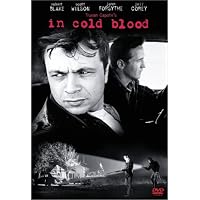
Average Reviews:

(More customer reviews)Are you looking to buy In Cold Blood (1967)? Here is the right place to find the great deals. we can offer discounts of up to 90% on In Cold Blood (1967). Check out the link below:
>> Click Here to See Compare Prices and Get the Best Offers
In Cold Blood (1967) Review
When Truman Capote published his 1966 novel IN COLD BLOOD--a story based on the actual 1959 murder of wealthy Kansas farmer Herbert Clutter and his family--he single-handedly established a new type of printed literature. Factual accounts of real-world crime had made it into print before, of course, but in writing HIS book, Capote combined in-depth journalistic research with the techniques of fiction writing, openly folding the facts of the case into invented dialogue and, for aesthetic purposes, sometimes combining the case's less important actors into single fictional characters. Capote himself referred to IN COLD BLOOD as a "non-fiction novel," and this approach to retelling real-life crimes in a pulp-like literary format would eventually evolve into the true-crime genre that is popular today.Maverick filmmaker Richard Brooks saw the potential of Capote's work as a basis for an aesthetically literate and thematically powerful film and subsequently adapted it for the screen. Producing and directing the film himself, Brooks collaborated with talented cinematographer Conrad L. Hall to create a film that challenged the established Hollywood conception of what movie is supposed to be. Brooks rejected studio pressure to make the film in color, to cast well-known stars in the leading roles, and to soften the story's matter-of-fact depiction of the murders. Instead, he wanted to make a film that, like the novel upon which it was based, seemed raw, hard-boiled, and true to life.
In spite of the violent and senseless nature of the real-life murders, Capote's novel was intended to ultimately evoke feelings that would make the reader repudiate support of capital punishment. Having grown close to the murderers during his research, the author attempted to depict them as merely misguided human beings who were deserving of sympathy, understanding, and, above all, mercy. Capote wanted the reader to understand that a state-enforced, publicly sanctioned execution of the two killers would, in effect, simply increase the number of victims in the Cutter murder case by two, and he thought that his pseudo-journalistic approach would disguise his real message in a seemingly objective narrative account of the events. Brooks wanted to retain Capote's underlying intent, and he and Hall both realized that stark, somewhat grainy black-and-white photography would give the film a documentary feel and thereby reflect the novel's pseudo-realistic tone. Brooks also knew that casting big stars as the primaries in the film would skew the audience's perception of both the story and the characters, as would any softening of either the murders or the executions. Brooks was so obsessive about creating a sense of verisimilitude, in fact, that nearly all of the filming was done on location in the places where the events depicted occurred--including the same Kansas house in which the Cutter family was murdered. In addition, six of the actual jurors from the trial of the killers appeared in the film's trial scene, some of the extras in the film were real-life neighbors of the murdered family, and the hangman in the execution scene was THE hangman at the execution of the real-life killers!
So Brooks stood firm and got to make the film he wanted to make. And as the writer/director undoubtedly expected, IN COLD BLOOD generated controversy for its gratuitous violence (this in spite of the fact that the killings in the film occur outside the frame), its sympathy for the murderers, and its anti-capital-punishment stance. However, if the film--as well as its source material--has any flaw, it is the fact that it does not achieve its intended socio-political goal. The filmmakers and actors create such a sense of realism in the depiction of the cold-heartedness of the killings and the lack of contrition in the killers that, instead feeling a sense of injustice or cruelty when the murderers are executed, even the most liberal anti-death-penalty members of the audience generally go away feeling as though the killers got their just deserts. Nonetheless, IN COLD BLOOD is a well-made piece of noirish crime drama that has held up incredibly well over the years. As killers Perry Smith and Dick Hickock, actors Robert Blake--best known for his role in TV's BARETTA in the 1970s--and Scott Wilson deliver riveting, wholly believable performances. Conrad Hall's excellent cinematography does indeed give the film a gritty, documentary feel, and his excellent frame compositions simultaneously give an almost painterly quality to the imagery. Also notable is the jazzy score by Quincy Jones, which generates an early 1960s flavor without being too intrusive to the narrative.
IN COLD BLOOD earned Oscar nominations for Brooks' direction, his screenplay, Hall's cinematography, and Jones' score.
For the contemporary audience, IN COLD BLOOD might seem more socially or politically germane than ever in light of Robert Blake's relatively recent arrest and pending trial for the alleged murder of his wife. Ever since Blake was taken into custody, one of Conrad Hall's most famous shots from IN COLD BLOOD keeps popping up on TV in newscasts and such. The shot centers on Blake's face the night his character, Perry Smith, is scheduled to be hanged, and as he gazes out a rain-spattered window, the light shining through gives the impression that a torrent of tears are streaming down his face.
The DVD from Columbia/Tristar offers relatively nothing by way of extras, but the digital transfer is very good. IN COLD BLOOD is presented in anamorphic widescreen in the original 2.35:1 aspect ratio, and though some filmic artifacts like scratches and dust appear from time to time, there are no visible digital artifacts. The black-and-white photography comes across with what is obviously the intended amount of contrast and graininess. The soundtrack is available in English via Dolby Digital 3.1 SurroundSound and in French via Dolby Digital 1.0 Mono, with little noticeable hiss or distortion. Would've been nice if Columbia/Tristar had included a little bonus documentary about the real murder of the Clutter family, but this is nonetheless a very worthy disc to add to the collection of any film aficionado.
In Cold Blood (1967) Overview
The true story of a callous murder of a prosperous and respected Kansas farmer, his wife and two teenage children by two ex-convict drifters.Genre: Feature Film-DramaRating: RRelease Date: 1-MAY-2007Media Type: DVDWant to learn more information about In Cold Blood (1967)?
>> Click Here to See All Customer Reviews & Ratings Now

0 comments:
Post a Comment