Average Reviews:

(More customer reviews)Are you looking to buy High and Low (The Criterion Collection) (1963)? Here is the right place to find the great deals. we can offer discounts of up to 90% on High and Low (The Criterion Collection) (1963). Check out the link below:
>> Click Here to See Compare Prices and Get the Best Offers
High and Low (The Criterion Collection) (1963) Review
BEWARE: SPOILER ALERTVery rarely does a film improve upon the book on which it is based. It takes a visual master, working with an excellent screenwriter, to convey as much detail about a story as an author. However, Akira Kurosawa's High and Low manages to do it. The source novel, Ed McBain's 87th Precinct novel King's Ransom is a well written thriller that, nonetheless, doesn't really stay with the reader afterwards. Kurosawa, however, better known for his samurai epics, took McBain's story and gave it a depth never realized in the book. The famed director stays faithful to the novel, but fleshes out a simple detective story into a drama that makes social commentary as well as entertains.
McBain's Douglas King never really earns the reader's sympathy -- even though we can understand his motives. Toshiro Mifune's Kingo Gondo, in contrast, becomes a three-dimensional sympathetic character. Both men have their entire financial well-being at stake in the form of a hostile takeover bid for control of a shoe company. Both men, at first, behave selfishly, refusing to pay the ransom even though they are risking their chauffeur's son's life. However, McBain's Douglas King never shows the humanity that Mifune's Gondo does. Kurosawa adds a scene, not in the book, where Gondo pays the ransom and saves the kidnapped child. Even though his business deal is now dead and he is broke, he still reacts with relief and joy when the kidnappers return the chauffeur's son. It's an emotional payoff that McBain's book is sorely lacking and helps to flesh out the character.
Gondo is also a more sympathetic character partially due to the fact that his actions are at least partially dictated by Japan's rigid caste system. Japanese society is broken up into social strata whereby the rich and powerful expect the lower classes to know their place. This division of influence, unlike in the United States, is generally accepted, even by those on the lower end of the scale. This isn't just the way Mifune's Gondo thinks -- EVERYONE thinks that way in Japan. However, Kurosawa, while he understands the mindset of Japanese society, is also critical of it. Kurosawa shows that when Gondo pays the ransom and saves the boy, even at the cost of his financial well-being, the Japanese people, as a whole, hail Gondo as a hero. Our sympathies are clearly supposed to be with the chauffeur and his son, even though it goes against every principle of the Japanese caste system. This commentary gives High and Low a depth that McBain's novel lacked.
In the novel, McBain hedges his bets morally. One of the kidnappers is a vile hardened criminal. However, the other two kidnappers, a husband and wife, are more sympathetic, particularly the wife who doesn't know about the plan until it is already in effect. In the end, the kidnappers get away and the chauffeur's son, Bobby, refuses to aid police in their capture. In addition, the police are seen as somewhat disjointed with some detectives with personalities and egos that irritate other policemen.
Kurosawa, in contrast, concentrates on one central kidnapper, a vile person who exploits drug addicts to do his dirty work and then kills them when he gets what he wants. McBain's subplot about the husband and wife is distracting, even though his kidnappers, with their self-doubt and streaks of conscience, seem to be a more balanced and realistic portrayal. In addition, the police are seen as a cohesive unit who forgo ego in order to catch the kidnapper. However, this is more a reflection of Japanese society, with its emphasis on team effort rather than individual glory, than a pie-in-the-sky idealized vision of the police. McBain's portrayal of the police is probably close to what an American police squad is like. Still, Kurosawa's vision is more satisfying. The police pursue the criminal and bring him to justice. Ironically, the resolution of the film, made in Japan, is probably much more satisfying to Americans than the resolution of the book, written by an American.
King's Ransom has an interesting plot. But author Ed McBain has only provided a good skeleton of a story. Akira Kurosawa, in contrast, has taken the exciting, but conventional story and turned it into a memorable cinematic masterpiece.
High and Low (The Criterion Collection) (1963) Overview
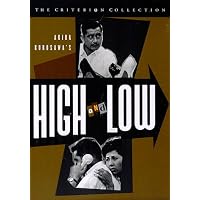
Toshiro Mifune stars as a wealthy industrialist whose family becomes the target of a ruthless kidnapper in Akira Kurosawa's exemplary film noir. Based on Ed McBain's detective novel King's Ransom, High and Low is both a riveting thriller and a brilliant commentary on contemporary Japanese society. Criterion is proud to present High and Low in a luminous new Tohoscope transfer with new electronic subtitles.Want to learn more information about High and Low (The Criterion Collection) (1963)?
>> Click Here to See All Customer Reviews & Ratings Now

0 comments:
Post a Comment