Average Reviews:

(More customer reviews)Are you looking to buy Gods and Monsters (1998)? Here is the right place to find the great deals. we can offer discounts of up to 90% on Gods and Monsters (1998). Check out the link below:
>> Click Here to See Compare Prices and Get the Best Offers
Gods and Monsters (1998) Review
At one point in "Gods and Monsters," Ian McKellan's character, James Whale, gestures to his head and remarks, "The real monsters are up here." The film spends its entire creating a way of life around this observation, portraying the last days of the well-known film director in ways that evoke humor, touching emotion, and above all else, emotionally haunting reflection on one's life.It's a most unusual film, not completely a biopic, yet not entirely fictional; it's more of a speculation on his latter days, based on the novel "Father of Frankenstein," written by Christopher Bram. The reality of Whale's life, from his superior and delectable wit to the memories of war and Hollywood that delight and haunt him, is the basis of the novel and the film, as Whale relates them to a young gardener in whom he takes an emotional and physical interest.
The story begins by introducing us to Whale's way of life, from his slowly deteriorating health and mental state, to his luxurious home, where he lives with his maid, Hanna (Lynn Redgrave), who is caring yet keeps up a stern demeanor when it comes to his dealings in homosexuality. The presence of the new gardener, Clay Boone (Brendan Fraser), strikes a chord within Whale, who resumes his sketching by asking the young ex-Marine to pose for his drawing, offering a face-only clause as a way of quelling Clay's obvious insecurities.
The film's own openness with the issues of sexuality effectively portrays the flamboyance of its main character, who apparently saw no shame in his ways despite the resentment of homosexuality in the 1950's. The movie embodies this ignorance in Clay, who, at first, is unaware of his newfound friend's orientation. Once he discovers the truth from Hanna, his discomfort becomes even more unstable, to the point where he storms out in a rage of fury over the old man's excessive way with discomforting words. And yet, he returns to act as Whale's model, intrigued by the heartwarming and heartbreaking stories he offers as he sketches.
This is a most fragile and unsteady friendship, yet in spite of the discomfort that surrounds their bond, their is a certain degree of comfort to be found within it. This stems from director Bill Condon's avoidance of character glorification: in "Gods and Monsters," everyone has flaws. We see Whale's mood swings, his obsession with young boys in his old age, and his reluctance to recall his past; Clay also spends his time running, from his family, commitment, and stability. Ultimately, this makes their friendship mutually beneficial, allowing Clay a broader, richer view of life while allotting Whale the chance to face memories he would otherwise hide away forever.
All of this is painted in broad strokes by Condon, who employs humor, wit, and sadness into his stunning adaptation. The discomfort that arises as a result of Clay's discovery of his friend's sexuality is handled lightly in earlier scenes, slowly gaining resonance and meaning as the plot moves along its dreamlike path. Whale's memories of filming the "Frankenstein" movies are realistic in their approach, while his recollections of war and his lost love are emotionally charged. All of this is given a slow yet mesmerizing pace that allows us into the deepest subconscious of the characters, so that we not only see what is going on in their minds, but can feel it as well.
In the film's favor is its credible casting choices, most notably McKellan, who employs wit and real emotional range as Whale. Making sudden and drastic jumps from jubilant to unstable, McKellan's Whale is portrayed as someone whom we feel for, a man whose life is put into perspective in a manner that calls us to look at it with unblinking eyes. Fraser evokes a subtle sexual tension and eroticism as Clay, whose resemblance of Frankenstein's monster is the focal point of Whale's fascination. Redgrave makes a wonderful turn as Hanna, putting her wit and sarcasm to good use as the woman who embodies a maid, a wife, and a mother all at the same time.
Above all else, the most perplexing aspect of "Gods and Monsters" is its connection to Whale's film, "Frankenstein." Clay's resemblance and sense of naivety when in the presence of Whale is very much like the scene from that earlier film that this film's final scene. Seeing that final scene is to finally realize and acknowledge the film's purpose; it's one of those forceful moments in cinema that only come once in a blue moon. The film itself is a most touching achievement, deriving its success from its examination of Whale's life in a manner that makes it compelling rather than interesting.
Gods and Monsters (1998) Overview
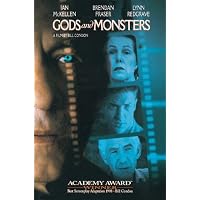
Ian McKellen delivers a riveting award-winning performance as Hollywood horror director James Whale. It's 1957 and Whale's heyday as the director of Frankenstein Bride of Frankenstein and The Invisible Man is long behind him. Retired andia semi-recluse he lives his days accompanied only by images from his past. When his dour housekeeper Hannah (Lynn Redgrave) hires a handsome young gardener Clayton Boone (Brendan Fraser) the flamboyant director and simple yard man develop an unlikely friendship. This powerful and poignant relationship will change their lives forever.System Requirements:Starring Brendan Fraser Ian McKellen Lolita Davidovich Lynn RedgraveDirected by Bill CondonRunning time: 105 minutesCopyright Lion's Gate 2003Format: DVD MOVIE Genre:DRAMA Rating:R UPC:031398833222 Manufacturer No:71872Want to learn more information about Gods and Monsters (1998)?
>> Click Here to See All Customer Reviews & Ratings Now

0 comments:
Post a Comment