Average Reviews:

(More customer reviews)Are you looking to buy Bellini: I Puritani (2010)? Here is the right place to find the great deals. we can offer discounts of up to 90% on Bellini: I Puritani (2010). Check out the link below:
>> Click Here to See Compare Prices and Get the Best Offers
Bellini: I Puritani (2010) Review
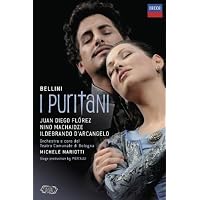
The Met's HD broadcasts have been going on long enough that their mongrel offspring are turning up in other parts of the globe. A 2009 PURITANI from Bologna shows a clear influence in its cinematic aspirations and specific camera angles and movements. It lacks the Met's high polish, though -- the editing inflicts some poor sequencing, and a camera behind the singers looking out into the house is a mistake, as the orchestra pit and conductor are incorporated into shots, inimical to a viewer's involvement in the drama. The sound recording has zero theatrical resonance, achieving a level of dryness that calls to mind the old Studio 8H. That clinical closeness is just what the Bologna Orchestra and Chorus do not need; their work does nothing to counter their reputation as a third-rate ensemble, and one could hear better playing and choral singing in almost any medium-sized North American city with an opera company. The problem is not obvious wrong notes or poor tunings as much as a generalized "blatant" quality: crude balances, ensembles that begin with a shudder or an unwritten staggered entrance, dynamics that are restricted to loud and soft without a range of hues in between, earthbound phrasing, and a lack of the ease and technical security that make finer points of rubato possible. As such, it is difficult to say much about the work of conductor Michele Mariotti, 30 years old and as photogenic as the people on the stage. It isn't a distinguished reading, but distinction may not have been possible with these scrawny strings, anemic winds, and diffident brass as a starting point.Pier'Alli's production could be described as moodiness on a budget. No matter the emotional or dramatic content, whether the action is supposed to be indoors or outdoors, every scene is played as if in deep night. Sets are utilitarian, although there are two good atmospheric events: stage fog at the opening of the opera and (the highlight) Elvira in her mad scene attended by a group of mysteriously veiled black-clad minder ladies carrying globed lanterns. Costumes are handsome in the traditional capes/boots (men) and gowns (women) period-accurate fashion. Blocking is unambitious -- principals and chorus tend to line up in rigidly formal patterns. At various points in the opera, one half-expects them to start moralizing at the audience (as in the endings of DON GIOVANNI and THE RAKE'S PROGRESS).
The one clearly world-class contribution, and surely the reason for Decca's involvement, is that of the Peruvian superstar tenor Juan Diego Flórez as Arturo. If this is not one of his greatest performances (a labored quality creeps in here and there), it is a strong and characteristic one, with his trademark bright tone, quick and tight vibrato, and elegant address. His soprano partner, Nino Machaidze, has a decent technique that at moments is better than decent, but she's a curiously unsympathetic Elvira, partly but not entirely due to her brittle and colorless vocal quality. That may not have counted against her so strongly were it not for a remote and studied stage presence. In the first act, she seems to be marking time until the mad scene, and it's telling that her most appealing moment in all of nearly three hours is the one in which she breaks character (bashfully smiling following a stage kiss with Flórez and a protracted ovation, amidst Elvira's epic mental-health fluctuations in Act III). Mostly she keeps us at arm's length with gestures of the rote semaphore variety.
There is more of the same from the third point of the love triangle, baritone Gabriele Viviani (the one principal whose name is left off the package's front cover and spine). Viviani acts primarily by reaching out with his right arm. When he really wants us to know he's feeling something deeply, he reaches out with his right arm *and* closes his eyes. He is one of the more handsome figures one will see on an opera video. Like every other man in this production (including even the front-line choral ones), he has thick, glossy hair and rocks a goatee. He also has a pretty vocal tone, but like many a baritone in this part, he can do no more than feint at the rudimentary florid demands of his Act I aria. Throughout, he makes the pitches but lacks vocal weight, especially in the part's lower third, where he's almost inaudible. His featherweight baritone and the quasi-baritonal bass of Ildebrando D'Arcangelo (a fine Dulcamara, Leporello, and Mozart Figaro on other DVDs) come to a predictable effect in the big Act II duet. D'Arcangelo comes closest to Flórez for artistry and savvy, thoughtfully plotting out his lines, but he is less than convincing as a gray eminence. When this Uncle Giorgio thunders, "My hand has not yet grown cold!" one is apt to think: "No kidding." There is a very pleasant bonus: a firmly vocalized and dramatically potent Enrichetta from mezzo Nadia Pirazzini, all but stealing the show for that character's half of one scene.
PURITANI has not yet been lucky on video. Admittedly, Bellini in general is difficult to realize in theatrically dynamic ways -- his operas, for all the beauty of their music, tend toward formal stasis on the stage. This does not excuse the major shortcomings of all three DVDs I have seen. Each production seems to have been built around an international star, and much of what surrounds the star reeks of "whatever we could get." From 2001, the Liceu/TDK's Edita Gruberova has a stylistic authority out of the reach of either competing Elvira, but she is heard in the extreme maturity of a long career. Maestro Haider is the strongest conductor of the three, and the tenor (José Bros) rivals Flórez for security if not charisma. But the baritone is a scowling stiff with a good voice, and the bass is weak in all respects. The Liceu production attempts the most of the three dramatically, but is marred by misjudgments (e.g. Riccardo holding his sword at Giorgio's throat). From 2007, the Met/DG boasts one of the world's great opera orchestras, but this was one of the most unfortunate Met broadcasts in 30+ years of same -- the production is old and shows it; Maestro Summers's vacuous strumming along in the pit betrays a poverty of imagination and initiative; Anna Netrebko's florid technique is not nearly up to Elvira's demands, even if her dramatic involvement and physical glamour are ideal; and the male cast is dismal across the board, the whimpering tenorino being the most debilitating principal in any of the three performances. The 2009 Bologna reviewed here has the worst orchestra by some measure, but the best tenor and bass by an equal measure. Its other cast members at least are not difficult to endure. These qualifications and the opening of some cuts (this performance runs 15 minutes longer than the Liceu's and 25 minutes longer than the Met's) give the new Decca an edge, although I declare it the best available PURITANI DVD without much enthusiasm. For greatness in this opera -- anything approaching the sustained dramatic intensity of Callas and Di Stefano under Serafin (EMI); the uniform vocal splendor of Sutherland, Pavarotti, Cappuccilli, and Ghiaurov on the second Bonynge recording (Decca); and the fastidious and vividly atmospheric conducting of Muti with Caballé and Kraus (EMI) -- return to your CD collection.
Bellini: I Puritani (2010) Overview
Want to learn more information about Bellini: I Puritani (2010)?
>> Click Here to See All Customer Reviews & Ratings Now

0 comments:
Post a Comment